Pages

Thursday, May 17, 2012

Body Fat Check, and Strategy Sheet for Jemez 50K Trail Race

A quick check-in to my blog before I leave tomorrow for the Jemez 50K race. Two things are going on:

1) I had my body fat analysis redone last night. I thought I had packed on a couple pounds after New Jersey Marathon with some junk food post-marathon "runger"-based eating. I wanted to see what the damage was. Well, my last test was April 4 where I was 19.3%. That equated to 29 pounds of fat.

So this time, while my weight was up a few pounds, my body fat came in almost a full percent lower at 18.5% of my body weight! How? Because I had actually gained some lean muscle mass in the last 50 days, a full 3 pounds of it.

This is a great mental boost going into race day on Saturday!

2) Jemez preparations have come along nicely. I'm a planner, and I took my experiences from my trail races so far and said, "What would I want to know out in the middle of a race?" And from this I made my strategy sheet.

I've learned through racing to turn off my auto-lap because the miles the GPS records aren't the most accurate, especially on a course with elevation. Then I hit the lap button at each aid station where I know from the race manual / website how far I've gone and can try to figure out what pace that represents with the limited carb-depleted math skills I have remaining.

And I hate trying to remember, "How far to the next aid station?" and "What's the elevation like coming up?" I'm out there on the course a LONG TIME so "go with the flow" just doesn't help me manage my energy level that well.

So here's my strategy sheet. I didn't make it into a strategy wristband as I have for other races (and PRed at other races with my band). I hole punched and will pin it to the front of my shorts so I can just angle it up and read it. Important notes to myself are in red.

Yes, it even has the elevation graph for a couple between aid station spots.
In the box, it shows how long that jaunt from aid station to aid station should have taken at different paces. So I should be able to lap my Garmin, see 1:48 at Mile 16.4 and say, "okay, that section took me 18 min/mi".

Here's the backside of the same card. Notice here that the last big aid station is 11 miles from the finish. The remaining two aid stations will have water and very limited food, and when your slow, limited food may mean no food by the time you get there. So I have a big note to not leave the aid station at mile 20.2 without filling the pockets of my pack with potato chips and cookies, HA!

So we'll see how well the strategy sheet works, but for a planner/analyzer/data junkie like me, it's never steered me wrong before!


Tuesday, May 15, 2012

Puking in my VO2 Mask

It was time to redo my VO2 testing (more info on VO2Max testing from Runner's World) at the gym. I actually had thought we'd last tested 3 months ago, but when we did the test and pulled up the old data we saw that it was 68 days ago. I tried to push myself during the test as close to my max heart rate as I could get and yet not throw up. And yes, I managed to avoid puking in my VO2 mask, but I got close enough that my trainer and I were both googling for videos of people puking into VO2 masks to include in my blog entry. Sadly, or fortunately for all of you, depending on your perspective, I scoured the internet and could find no such videos. Boo.

Here's what happened at my last test. And what did we hope to see this time?

  • We didn't expect my aerobic base to really move, because I'm pretty efficient at my base so it would take a lot of work to move that, and it hasn't been long enough.
  • We didn't expect my anaerobic threshold to move either, because I haven't been doing extremely high intensity speedwork at a very very high heart rate.
  • We did hope to see that the big negative slope in efficiency that we saw between the aerobic base and anaerobic threshold last time would have leveled off some. This would be because of spending a lot more time training at Zone 2 and Zone 3, those uncomfortable zones. This would allow me to race at higher heart rates and faster paces without burning through my glycogen (carb) reserves as quickly.

Disclaimer

I'm not an exercise physiologist, kinesiologist, or any other -ologist expertly trained in VO2 testing and its results. I'm an average runner, who passed the test to be an RRCA-certified running coach, and understands a lot of the rudimentary things about VO2. But I may misstate things here, so always do your own research and consult with someone smarter than me!

The Actual Testing

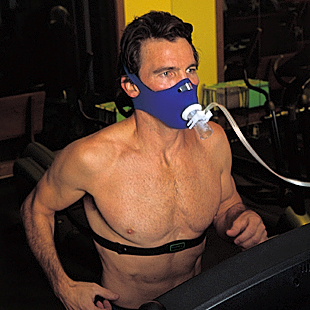
So the test works like this. You wear a super sexy blue mask. And you wear this mask for 10-11 minutes in the middle of the gym in my case in front of the whole world. 
This is what the testing looks like. P.S. This is not a self-portrait.
Then, my trainer Donnie, who is trained and certified within his gym to analyze the raw data, starts the treadmill at 3 mph. So word of warning, get the test done with someone who is actually trained in it. Not someone who owns the equipment and runs the machine and makes the computer do all the work. Because you really want a professional reading the test data and helping you interpret so that you know what it means!

The wires hooked up my mask read the oxygen and carbon dioxide levels to figure out when and how I use the oxygen in my body efficiently. 1-2 minutes at a time we move up to 3.5 mph. 4.0 mph. 4.5 mph. 5 mph. Then we start raising the incline, 2%, 4%, 6%. At 8%, it's starting to hurt, but I'm trying to keep that heart rate in check. Unlike the last test, we actually reach 10%. And I hold on, at 12 minute per mile pace and 10% incline, for about 20 seconds. Until I have to jump off and cling to the sides as I almost spew into my very tight mask.


Results

One easy way to sum it all up is comparing my VO2Max number.

  • Before: 36.5
  • After: 42.1

That's a huge jump! 17% increase in only 68 days! I had a VO2Max that was expected for a normal female, or in my case a female marathoner with bad genetics. Boo. And now I have a VO2Max that sounds a lot more like a standard athlete. Yippee!

From a Runner's World article about improving VO2Max:
"If you want a high VO2 max, choose your parents carefully. One group of scientists concluded that heredity determines up to 50 percent of your endurance ability. Still, that leaves 50 percent that can be influenced by training. While an outrageous VO2 max isn't the only ticket to running greatness--Frank Shorter's and Alberto Salazar's maxes were in the low 70s--increasing it can boost your race times. A five-point jump, for example, can translate into a seven percent improvement, or 90 seconds for a 20-minute 5-K. And a moderately fit runner can increase VO2 max by as much as 25 percent."

Further, the % of calories that come from fat at higher heart rates has gone up. That means I'm more efficient at higher heart rates in Zones 2 and 3. So I can go longer pushing at those heart rates, burning fat calories. See the numbers in Zone 2 - before I burned 37% of calories as fat calories, whereas now I burn 42%. Even better is that strong negative slope of declining efficiency in Zone 2 has almost completely leveled out! And my efficiency in Zone 3 went up quite a bit too. I knew this from anecdotal evidence because I had spent about the last 6 miles of the NJ Marathon, when I was working to finish with a PR, at Zone 3 thanks to cardiac drift. But with increased fat-burning efficiency, I could do that where I could not have before!


More data for those who like data like I do...

Final Conclusions

What does this all mean for upcoming races? So where do I go from here?

  • It means that I can hang out anywhere in Zone 2 for quite a while and still have a very high fat-burning efficiency. Before, I knew to hang out no higher than low Zone 2.
  • I can race for about an hour at low- to mid-Zone 3 where before I would have sputtered out of energy.
  • I can use the calories per minute burned calculation to verify that I'm taking in enough nutrition during ultramarathons. I need about 200-250 calories per hour in a race to keep the engine fueled well it appears.
  • Do not ever hit Zone 4! Look at how many calories I burn per minute there! 13. And it's all carbs. So a half hour of that burn equals more than an hour of happy fat-burning effort. I'd burn through my energy reserves quick. And even if the heart rate zings up and hits Zone 4 briefly, you can keep burning pure carbs for a while after it pops back down. In an ultra, this would get me to a quick DNF. So no Zone 4!

So Friday it's time for a trip, and Saturday I'll be running Jemez 50K with all this new data loaded into my Garmin Forerunner 910, and all this knowledge driving my efforts and my paces! Jemez, here I come!

Monday, May 14, 2012

Is Jemez 50K a Bad Idea?

I was having a bit of a freakout the past couple days about going to Jemez 50K race this weekend. Was signing up a bad idea?
Very very rocky in some sections - I don't see a path, do you?
I knew one good thing about having it on my radar was that it was distracting me from the freakout of the eventual end goal of running the Chattanooga 3 Day Stage Race on June 15. Jemez was a good plan because it was a countdown to Chattanooga without being a constant reminder of Chattanooga; running the race would signal basically the start of my multi-week taper for Chattanooga.
One of the monster downhill grades
But I'm an anxious, high-strung person naturally. I work on it, but it's who I am at my core. So now I'd added an event on my calendar with Jemez that would be both incredibly rewarding and yet very stressful all at the same time. Add to it that two runners I know had recently had hard races tied to elements I would deal with at Jemez (one with altitude and another with technical terrain and difficult elevation).

So steep, they are stairs!
Why does Jemez 50K as a training run give me anxiety?
  • I will be finding out how my body reacts in altitude conditions (7000 ft minimum at this race). 
  • I will be doing some enormous climbs, up to the top of Pajarito Mountain at 10,440 ft and back down. 
  • I will be running on my feet for probably 10 1/2 to 11 hours. Funny how 8 hours doesn't phase me too much anymore (I've run over 8 hours 4 times before), but 11 hours feels very different in my head from 8.
Watch out for loose rocks!
So I did what anyone else with a running coach should do: I sent him a note about where my mind was at right now.

He had a great response that reaffirmed why I am doing this. It will be an excellent amazing training run for Chattanooga BECAUSE...
  • Jemez will be further and longer than any day in Chattanooga
  • The elevation gains and grades will be much harder at Jemez than Chattanooga
  • Jemez is supposed to be pretty technical, maybe more so than Chattanooga, plus I'll be exposed in unshaded terrain on sunny days more than the woods of Chattanooga.
  • I'll deal with all this on top of altitude, and I won't have altitude at Chattanooga.
  • Good chance Jemez could be as warm as or warmer than Chattanooga.
So I keep my wits about me, stay calm, keep moving forward, and Jemez will be such a great training race!
One of the views I'll be rewarded with!
My goals with Jemez from my coach are simple, well, as simple as they can be completing 31 miles in hard terrain... :-)
  1. Get in and out of the aid stations quickly. Something he's worked on with me and I showed I can do when I set my mind to it at Hells Hills 25K this year.
  2. Powerwalk those uphills. Be smart about running and walking at the right time. Run when I can, powerwalk when running isn't the most efficient.
  3. Keep on top of my food and hydration. I've worked on that this spring and this is another chance to show that, especially when dehydration is easier at altitude and makes altitude sickness worse.
Note all pictures were courtesy of Bill Geist, the race director, from the race website

Friday, May 11, 2012

You Are Good Enough

Some runners/triathletes comments, FB statuses, tweets, blog posts make me sad. They are insecure. They are striving to correct an inadequacy in their life through their athletic achievements. They have routines and lives that don't excite them. They are not motivated by aspects of their lives. They have a void.

And the mantra I always keep in my mind to combat any occasion where the world or myself wants to tell me otherwise is...
You Are Good Enough.
Let's all say it together. You ARE good enough. YOU are good enough. Finally... you are good ENOUGH!

The word enough is important because we're not perfect, we don't have to be perfect.

I'm very motivated by everything going on in my life. If I wasn't, I wouldn't do it. It took me part of my 20s to come to that obvious conclusion. I do what I want, and I make those things a priority. I make memories.

I love my family. I love being a wife. I love being a mother. I love following my passion to volunteer and to own a small business where I'm poorly paid, and okay with that, so I can pursue providing opportunities where people can celebrate their victories. I do training that I enjoy and run races that have a purpose to me. I volunteer to support my fellow runners. I text and tweet with friends who I would count in "Team Libby" and who I always hope I show them that they should count me in their team too.

I'm a companion to Steve.
I'm a caregiver and guiding force to Marissa to Sophie.
I produce running races to give people a place to feel enough and celebrate their victories or push their limits.
I head up a running club so that people can have that feeling and place of belonging between races.
I run 99% outside so I see the world where every run is different, even on the same route.
I choose races that allow me to have incredible experiences and make lasting memories.
I challenge myself often to dream big in everything I do.
I have friends in my life who live strong and work to feel worthwhile in their daily tasks.

I am happy with each day, and I know that I'm good enough so I don't have to prove it daily to myself or to others.

I'm a sharer and in weak moments, I can get attacked that I'm doing it wrong, that I'm not to complain about the path, that I'm not allowed to question the path. Does it mean it's the wrong path? No. Does it mean I'm wrong to share anxieties? Also no. I'm human.

I can choose to better myself or challenge myself, but that basic framework always remains. Do you struggle with this as I see others do?

So repeat after me... You. Are. Good. Enough.

Wednesday, May 9, 2012

The Effects of Altitude on Pace - Preparing for Jemez 50k

Jemez 50K is 10 days away. I've read a couple race reports from friends, and I'm not ashamed to clearly say it scares the dickens out of me. Michelle ran a 9:38 at the 50K there last year, and she's a FAST runner. Nick ran the 50M there and warned me it would be the hardest race I've ever done. I've never run at altitude, I've never even vacationed at altitude. I'm nervous.


Now I know so much of race day can skew finish times wildly. Things like:

  • Weather conditions
  • Altitude sickness - headache, nausea - aside from the general effects of difficulty breathing
  • How technical the trail is
  • Elevation grades

But I'm a planner, and I wanted to have a general idea of pace in my head before I get there. Can I expect to be running for 8 hours, or 11-12 hours??? That's a wide time range that I wanted to narrow down a little if possible. The biggest question to me is the effects of running at high altitude. Running 31.1 miles doesn't scare me anymore, running up a mountain and back down doesn't scare me, but starting a race 7000 feet above sea level and then climbing to 10,440 feet at the top of Pajarito Mountain - that scares me.


I found a cool running calculator online, but I'm not sure how real the results are. It's located here:
http://www.runworks.com/calculator.html

And they sum up the calculator this way:
"The running calculator uses the distance and finish time of your most recent race to approximate your current level of fitness. Your performance is the result of many factors, including the maximum rate at which your body can process oxygen, your lactate threshold, and the mechanical efficiency of your stride. The calculator lumps the effects of all these factors into a single variable called VDOT, using a method popularized by sports scientist Jack Daniels in his book Daniels' Running Formula. 
A given VDOT value corresponds to successively slower average paces for longer distance races. For example, a 24:00 5K race time (7:44/mile pace) represents the same VDOT value and overall level of fitness as a 49:47 10K race (8:01/mile pace). Once your current VDOT has been determined, it can be used to predict your race times at other distances. The closer the other distance is to the original race's distance, the more accurate the prediction will be. Due to differences in physiology and training, some people may be better at longer distance races than shorter ones or vice-versa, but the calculator should yield accurate results for most runners. 
The recommended training paces are also determined from your current VDOT value. They correspond to the five primary training types as defined by Daniels: everyday easy runs, marathon pace runs, tempo (lactate threshold) runs, intervals, and repetitions. These training types and the purposes served by each are explained fully in Daniels' book.
The data for pace/time adjustments related to elevation, temperature, and wind speed are adapted from Daniels' chapter Utilizing Your Training Environment, in the 1st edition of his book. See the text for more information."
Very, very cool. You can alter by elevation, by altitude, and like the McMillan calculator, gives you suggested finish times for other distances than the one you enter.

Jemez is 7000ft elevation gain. Gorge Waterfalls 50K back in March was 6500ft elevation gain with some similar grades, so I put that in because that race was at sea level. So it mostly varies the altitude without having to consider a difference in elevation changes.

So I entered the 8:30 finish time from Gorge Waterfalls and clicked the altitude adjustment, and here's what they came back with:


ElevationTimemin/kmmin/mile
sea level8:30:00.010:11.416:23.9
1000 ft (305 m)8:36:52.110:19.616:37.2
2000 ft (610 m)8:43:44.210:27.816:50.4
3000 ft (914 m)8:50:36.310:36.117:03.7
4000 ft (1219 m)8:57:28.410:44.317:16.9
5000 ft (1524 m)9:04:20.510:52.517:30.2
6000 ft (1829 m)9:11:12.611:00.817:43.4
7000 ft (2134 m)9:18:04.711:09.017:56.7
8000 ft (2438 m)9:24:56.811:17.318:09.9
9000 ft (2743 m)9:31:48.911:25.518:23.2
10000 ft (3048 m)9:38:41.011:33.718:36.4


Since I'll be running at 7000 to 10000 feet the whole time, I'll assume a handicap of 45 minutes to 1 hr 15 minutes, and then probably handicap myself another 30 minutes for the mountain climb and my recent fatigue of running 3 marathons in 3 weeks. I'm therefore going in prepped for the idea of running 10 hours 15 minutes. Let's see how this goes.

Again, I know to take what the race day gives me. But having an educated guess of how the day will go is a lot more settling than having a complete question mark over the whole race day, at least for this analytical mind! I'll see you on the other side of Pajarito Mountain!

Oh, and who has data from their own running to support or debunk this calculator for altitude changes? I'm really curious!

Tuesday, May 8, 2012

2012 New Jersey Marathon Race Report

The New Jersey Marathon was a training run. Yeah, saying that never feels natural. After Garmin Marathon in the Land of Oz (and a new PR) two weeks ago (race report here), I had Oklahoma City Marathon a week ago (race report here), and now I was going for 3 in 3 weeks with NJ Marathon.
My favorite picture of me at the New Jersey Marathon


I flew into Newark 2 pm on Saturday, picked up my rental car, and survived the Jersey turnpike and the Jersey folks' aversion to left hand turns on roads (I learned quick about Jughandles) for a 1 hour drive to get to the race expo before it closed at 6 pm. There was no race day packet pickup option. The overly hyped expo began to disappoint with the half hour wait to go a couple tenths of a mile to park in the parking lot. Ridiculous. Really truly ridiculous.

The race expo was where the start would be. A first for me, it was at a race track. Yes, like horse races. The Monmouth Race Track in Oceanport, NJ.

I finally got parked and followed the masses of horseracing fans and runners (odd mix) inside.

Once inside, it was kinda an icky place. Worn down, a puddle in one spot with one of those yellow folding Caution signs over it, a bathroom with leaky faucets, and a mishmash of expo booths and line for people placing bets for upcoming races. I never saw the promised expo speaker area for their big seminar series, and the vendors were all the usuals only, maybe like 15 booths. If you've been to one expo, you've seen it all before. Half the booths were for other races owned by the same race production company. Picking up the packet took two seconds. The race shirts were nice long sleeve tech shirts. Although I don't know that having the race map on the back was my favorite thing - it's not some amazing course on paper, it's an out-and-back along the shore.

Grumbly from all the out of the way traveling for the expo, I went to meet up with my friend Eva at the mall close by. The general expo traffic made that take forever too. Grr.

Eva and I hung out at Starbucks for a bit and then headed to dinner: Shore Cafe in Hazlet. Great Italian food. I had gnocchi with meat sauce and a meatball. Yum.

We said we'd see each other in the morning, and I checked in to my hotel. With plane travel and a long day, I had worked hard all day long to keep up the nutrition and hydration. And then I couldn't get to sleep because of how much water I'd been drinking, ha!

Race Day - Logistical Trade-Offs

It felt like a bad math problem.
The half marathon started at 6:50 am. There were 6,000 in the half marathon.
The marathon started at 8 am. There were 2,000 in the marathon.
We had one gigantic parking lot to park in. Our only parking directions were that we would be able to park at the race site.
It was a 20 minute drive from my hotel.
When would you get to the race site?

From one point of view, I can understand the discrepancy in the start times. We share most of the same course the first 10 miles. They probably wanted to get the thousands of half marathoners off the course before the marathoners ran.

However, I knew parking would be a mess as a result. It was either get there super early and hang out in the car or park quite a ways from the start, which would feel awesome with tired legs that just went 26.2 miles and had to walk to the shuttle from the finish line to the start line.

I got up at 5 am. Left the house at 5:40 am. And then at 6 am, I spent 20 minutes in a crawling line to park. URGH! And now I'm at the race site 1 hr 40 min early. Yawn.

Again, I get what were probably their motivations, but man, there's got to be a better way. I wonder if they could have designated a close lot as the "Marathoner Lot" so that, if anything, we would alleve early traffic for the half marathoners and be able to arrive just as the race was starting at 6:50 am for the half marathoners. Except I think they ran the half marathoners right through part of the parking area. Ack, I don't know the solution. Maybe they could have started the full marathon as the early one?

Settled and Ready to Run

Eva and I met up and cheered the start of the half marathon.
Fast half marathoners at the front!

We saw a man dressed in fully derby regalia (we are at a race track after all) and posed for a picture with him.

We were messaging with Melissa from Austin. She and I were around the same pace and had agreed to start together and then see where it went from there. No obligations but great company! Perfect arrangement!
Eva, Melissa, and Me

It was a beautiful race day. Overcast but not too humid. About 55 degrees. Later it would get up to the low 60s, the skies would clear except for some white puffy clouds, and the sun would beat down. But it was never very hot.

The First Eleven Miles

The gun goes off. As much as I was worried about my left knee, or right foot, or any other area of my body that morning, I felt good. I could not for the life of me slow to the pace I had planned, 12:45 min/mile, but I was enjoying the gorgeous day.

We wind around and around and around. Like truly, it is a windy course where many many times you can see part of the course coned off right by you on the other side of the intersection or a block away.

Melissa and I stick together. Eva does run/walk intervals so we leapfrog with her plenty of times. We chat with a woman who is a 50 state marathon club member who is working on her second set of 50 states. But then she says she was in the hospital for cardiac issues a week ago and someone is going to take her blood pressure at mile 11 and decide if she can officially continue ??? Whoa, makes me nervous, and I thought about her afterward and hoped she was okay.

Late in mile 10 we pass within a couple blocks of the finish area and encounter lots of half marathoners with their medals and their families walking around. Great to know we have to go back out for 16 more miles to get our darn medal. ;-)

Miles 9 to 11 we're taking some extra walk breaks on Melissa's request. No problem, this is a training run, I'm not in a big hurry. But around mile 11 the walks were starting to mess with my rhythm, and I told Melissa I needed to go on. I was sad to leave her, I enjoyed running with her so much, I wasn't looking forward to 15 miles alone, but it was what I needed to do.

Miles Eleven to the Turnaround at Mile 19

Now we're on the out-and-back, and I can see the very fastest runners coming in to the finish about mile 25. It's a great distraction to focus on the runners coming back.

At mile 13, we turn at the corner of an intersection where there is a large pretty church named St. Michael's. It's on the right side of this picture.


It seemed like mass was ending, and there's lots of bells and organ music and flute music. It was very calming.

We turn at the church to head around a cute little lake. I think it was called Lake Takanasee (I remember because when I saw the sign, it made me think of Tallahassee!).

Back on the straightaway for mile 14 and beyond. I leapfrog with an energetic fellow who sprints way ahead and then walks. He yells out to every Marathon Maniac on the out AND the back. He's so into it all that he almost misses one of our turns!

I come across some TNT coaches who are walking with and helping out a guy. I try to piece together the story and almost get the impression that he found this was going on and just jumped in at the start, and now he was at mile 15 and wondering when to jump out. Like he wasn't registered. Like he wasn't a runner. It was very bizarre.

At mile 17, we cross a bridge of a pretty inlet. Wonderful view. And can I mention how nice the breeze was through most of the race?

Another half mile down the course, around another nice body of water!

At mile 18, we get onto the Asbury Park boardwalk! I've been waiting for this. Finally, the beach. Finally, the ocean. On the Jersey shore. Each open air bar and Italian ice stand is blasting catchy music, and it keeps me moving. The wood of the boardwalk makes me nervous at first that I'll catch a toe and fall, but then I find instead that it gives me a little spring in my step and I'm moving well on it!

We go through an old ripped-apart-to-the-framework casino! Yes, we actually run through it! And the first step inside of this unusual tunnel is a slick beautiful old marble tiled floor. I slow down and ensure solid mid-foot landing through it.
We ran through this around mile 18.5

Onto an asphalt section next, and then around a cute little green park area framed by gingerbread trim two story houses.

Mile 19, and the turnaround on the out-and-back course

Once we're around the park, we've officially turned around. It's mile 19, and we're heading back north to that glorious finish line.

The Pain Plateau

While going around that park, I do a self-check of what's going on with my body, and I realize the pains that had started to become stronger around mile 12 (which felt really early and scared me) are not really getting stronger or worse. I think I'm approaching my pain plateau, that moment in an endurance race, in the absence of injury, where generally it's not going to get any more painful than it is. Now it's just about sitting in that pain and swimming up to your nose in it for another maybe hour and a half and not giving up or losing my mind.

There's a joy in realizing that I'm at that point.

Down On The Boardwalk! Miles 19 to 21

Back onto the boardwalk from whence we came until right at mile 20 when we hit a new stretch of boardwalk. We go through another tunnel of old eroded casino. These tunnels were refreshing and fun!
Mile 20, we actually run through here!

After going through the tunnel, I stop a random stranger who is walking down the boardwalk and ask him to take my picture. He's not as quick about it as I would love, but he's kind and nice, and I actually love the picture that turned out. I feel like I look so happy and relaxed. I love it so much that I started the post with it and include it midway here too! ;-)

Makin' The Call - Literally and Figuratively

Around mile 21, we've exited the boardwalk and are back on the street. And I've spent the last two miles doing math in my head. And let me tell you that even when you have a degree in mathematics like I do, it's hard to do even basic math at mile 20 of a race! I wasn't hear to race a marathon, but I'm 7 seconds per mile ahead of my pace for my marathon PR set 2 weeks before at Oz Marathon at this point. Do I slow down and take more walk breaks? I mean I've hit the pain plateau but that has no reflection on the pain after the finish line depending on how I run this race. Do I race it and go for the PR? And what if I go for the PR and don't get it? Now I've burned the energy, have no PR to show for it, and have an even harder recovery and two weeks of training before Jemez 50K!

After hemming and hawing for a quarter-mile, I pull out my phone and do something that will sound crazy. I call my coach Jeremy. I need someone objective to tell me what to do. To put emotion aside and think for me for the endgame, for the Chattanooga Stage Race that's 6 weeks away. What is best for that training?

Aaaannnnd he doesn't answer the phone. Well, crap. Now I have to decide. And I'm going for it!

Now It's Time to Race - Mile 22 to Mile 26

Well, the numbers say it all...

First 20 miles - pace - 12:16 min/mi
Last 6.38 miles - pace - 11:54 min/mi
I haul butt. Funny story though that about mile 23 I come up to a Marathon Maniac who I recognize had run my New Years Double race! I introduced myself and correctly remembered his name was Chris. So funny to go so far away and meet a participant from one of my events. A joy!

I watch my heart rate zone from time to time. I keep it in a low Zone 3. If I go to Zone 4, I'll go anaerobic, and even if that's for a short bit, and even though it's only a handful of beats per minute above where I'm running in low Zone 3, hitting Zone 4 could make my recovery, and how I felt while traveling the rest of the day, feel truly miserable.

I stay strong and pass a good deal of walking runners. The sun is out and I get the feeling this is hard for those who live in that area. But it's still in the 60s so this Texas girl is loving it!

The last 2 miles I have a mantra that rhythmically has gotten into my head. "PUSH. PUSH. POWER. POWER." over and over again.

Sprint It In

I always think I'm dying, but I'm proud that I've learned how to find that kick at the end of a race. Relax the stride, control the breathing, pick the right time to speed up, and get this race finished. And the Garmin showed it...

26.0 to 26.2 -  10:43 pace
26.2 to 26.38 - 9:27 pace

I cross the finish line, hit stop on the watch, look at it, and I'm sobbing.

A New Personal Record!

5:21:43. I've PRed again at my 3rd full in 3 weeks. 1 minute and 20 seconds off of my PR set two weeks ago! After a particularly painful marathon a week ago. After I came out for a training run at a no-racing-intended pace.

I accept my finisher medal from a military man in uniform. It's a nice medal, a spinner medal, but I'm not big on engraving my medals and I wish spinners would have a snazzy two sides instead of one side being awesome and the other being a blank box to engrave your time. But still a very pretty medal.

I pose for a finish picture, which I rarely ever do since I barely ever buy them. But I do because I'm so giddy happy that I just might buy these.

I can't even get out of the finish corral before I'm dialing my husband, Steve. I cut to the chase as soon as he picks up because I'm worried he'll freak out about the heaving cries inbetween words. I'm so beyond ecstatic.

The Aftermath

And then I have to hobble to the shuttle to take us back to the start line. Ugh. And it's a school bus with three monstrous steps to get on and off. Ugh. And then I'm back and have to walk a couple tenths of a mile through the parking lot to get to my car. Ugh. Then I drive my car to the portalets at the edge of the parking lot near the start and have to use a very well-used portapotty to change my clothes and clean up. Double ugh. I use a bazillion baby wipes to get all the salt off. I didn't sweat heavily during this race, my clothes aren't too drenched at all, but I am salty. More deodorant and a hope that I can pass for somewhat human until I get back to Dallas and finally get to shower at 11 pm tonight!

First priority - coffee. Nearby Starbucks gets the job done.

Then I must try the famed White Castle that New Englanders tell me about. If it was good enough for Harold and Kumar to go through so much to get some, then I must too! And luckily, there's one only a couple tenths of a mile from the Starbucks stop.
Almost at White Castle

I can't say that I would want the sliders often of course, but for a treat and something different, they were yummy. I bought half original sliders and half cheeseburgers and liked the ones with cheese better.
White Castle Cheeseburger
Then, the 45 minute drive back to Newark airport. 7:15 pm flight back to Dallas. And I arrived at my house at 10:30 pm. LONG DAY!

Next Up

Jemez 50K in 2 weeks in Los Alamos, New Mexico. Excited for a fun, challenging, beautiful race. And it will certainly be challenging. My first race at elevation (7000 feet) and THEN we climb a mountain to 10,440 feet. And then back down. A couple simple goals for this race and overall finish time is NOT among them.

Splits


Final Chip Time: 5:21:43
First Half Marathon Checkpoint - 2:41:03
Second Half Marathon Total - 2:40:46
First 20 miles - pace - 12:16 min/mi
Last 6.38 miles - pace - 11:54 min/mi

Mile 1 - 11:37
Mile 2 - 11:46
Mile 3 - 11:50
Mile 4 - 11:57
Mile 5 - 11:59
Mile 6 - 12:14
Mile 7 - 12:01
Mile 8 - 12:19
Mile 9 - 13:00
Mile 10 - 13:07
Mile 11 - 12:56
Mile 12 - 12:32
Mile 13 - 12:26
Mile 14 - 12:28
Mile 15 - 12:01
Mile 16 - 12:16
Mile 17 - 11:45
Mile 18 - 12:29
Mile 19 - 12:28
Mile 20 - 12:29
Mile 21 - 12:27
Mile 22 - 11:35
Mile 23 - 12:17
Mile 24 - 12:19
Mile 25 - 11:52
Mile 26 - 11:45
0.2 miles by my Garmin - 10:43 pace
Remaining 0.18 mi to the finish - 9:27 pace