Pages

Friday, August 30, 2013

A 5K Straight Up The Mountain

The family and I had our first big on-our-own vacation (because Disneyworld is a totally different experience) at the beginning of August going to Denver, Colorado. It was also our first trip since Sophie was diagnosed with Celiac Disease. Thankfully, Denver is super gluten-aware and keeping her from getting sick wasn't as bad as we expected.

By coincidence during our planning, I had discovered that on Sunday while we were in Vail for a couple days, there would be a race called the La Sportiva Berry Picker 5K Trail Run starting just steps from our resort. Of course I signed up.

I picked up my bib the day before. No chip timing. The race shirt would be given out at the top of the mountain post-race (BAD IDEA: unless you were a frontrunner, no one got the size they had requested during sign-up).

I had deacclimated from the altitude tent (I'd been out of it for a few weeks), and, unlike Bighorn or Tahoe, I could feel the altitude here in Vail.
The bike rack reinforces why it's so hard to breathe!
I checked out the course a little bit the night before. I would be running up the mountain on the Berry Picker Trail, crisscrossing on switchbacks, nearby where the Eagle Bahn Gondola went up the mountain. In fact the race started right by the Gondola, then crossed on a bridge over a creek, before stepping onto the trail.


I'm going up THAT!

Yes, I get it. It. Goes. Up.

The trail had some decent pebbles and small loose rocks to contend with.

Looking back down the couple tenths of a mile up the mountain I went the night before.

Sunday morning, I walked out of the resort and 20 paces to where the start was. Sitting around waiting, I ended up chatting with a guy from Cincinnati who was also an ultrarunner. We chuckled at all the people warming up going a quarter mile up the trail and back down. I know it's appropriate for a 5K, but I hadn't done a 5K in 3 years! The first 5 miles in a race was my warmup nowadays. Just a different atmosphere completely.
Super casual packet pickup
We would be climbing 2,100 feet over the 3 miles, at a pretty constant rate.

We started and it wasn't long before we were all single file huffing and puffing up this mountain. I could tell from conversation that most people were locals and many of the ones who weren't had summer homes or timeshares here.

I huffed and puffed and was surprised at the technicality of this course. There were rocks, roots, and the morning dew and later yesterday afternoon shower had left the steeper uphills a little tacky and muddy. Switchbacks through the woods as we got higher were almost like eroded cliffs. We climbed over roots on roots in those sections. So many roots keeping the ground from just slipping away down the mountain.

I wanted to stop and breathe a lot of times. But I was determined to just keep moving the whole way. At mile 1.6 there was an older couple sweetly manning a small aid station for us.

A little further up was a bivouac - a wood a-frame for people to throw tarps on and take shelter. A little over 2 miles I was really asking myself, "WHAT AM I DOING HERE?"

A few minutes later, we came out of a wooded section and I glanced behind me and the morning sun on the mountains took my breath away (more than the elevation at that second!). And I truly had tears in my eyes. We couldn't see the gondola for most of the powerhike up. This was remote and isolated. I felt like the view I was seeing was special. That exact view could only be found by hiking up that steep trail to this point. It was all mine.

I gained on the folks in front of me in the last 1/2 mile. People were getting tuckered out, and this was when I felt my endurance win out. We hit the top and it turned into dirt road with a small downhill. People were spent and walking. I ran home road paces, 11:15 pace, for that 0.2 mile segment and got a cheer of surprise for my sudden speed at the top from two guys I passed. Then another BIG steep powerhike climb before the last 0.1 mile run-in.

I turned a curve and there was Steve and the girls. They've never seen me finish a race! Marissa had picked a little bouquet of wildflowers. Steve was trying to snap pictures and actually got this one before he had to drop the camera to stop Sophie from running onto the course. I ADORE this picture.


I bent down and kissed each girl while I huffed and puffed. I thanked Marissa for the flowers, took them, and turned to run the last couple hundred feet into the finish.

Coming into the finish corral, the announcer called my name and then I enjoyed the incredulity when he announced I was from Texas. A spattering of extra applause for this stupid flatlander who came to climb a mountain.

I crossed the finish line and went to collect my race shirt. Which again was a horrid Men's Medium because all the pretty periwinkle women's shirts had been claimed already. Grrrr.

My worst 5K ever, 1:14:40, and I was proud. :-D

And then I hacked up a lung for the next 20 minutes. I had seen folks do this after Bighorn and Tahoe, but I had the altitude tent working in my favor. Not anymore. My lungs were not happy campers with a race that finished at 10,200 ft altitude.

Even better than the finish was the fact that it had capped off a week of vertical training. A lot of hills. Miles may be low compared to lots of ultrarunners, but that week I hit 7,000 ft of VERTICAL. As an aspiring mountain runner, that's important. That matters.

So happy my girls could see me finish. And to later hear Sophie, when asked what mommy was doing on the mountain, say, "Mommy running." Prompted: "Mommy was running?!?" Sophie: "Yes, on dirt."

Yep, that's what I do in a nutshell. I run on dirt. ;-)

Can Runners Have Mental Injuries?

Yes, the answer is yes. We hear a LOT about plantar fasciitis, piriformis, and Achilles problems. I've been a really smart runner, and aided by fantastic coaches, trainers, and sports chiropractors to that end, so that I've stayed injury-free PHYSICALLY for 7 years of running (I had my first and only big injury in 2005 in my first year running and then realized I needed to be smarter about it!). But what do you do when you find you have a mental injury?

Well, I think I came back from Tahoe Rim Trail 50 Mile with a mental injury. After DNFing at mile 30 from heat exhaustion, I wasn't quite sure how to handle it. I had DNFed (Did Not Finish) an ultra before. But this one had blindsided me in a way others didn't. It was a goal race, I had prepared, and I had trained hard. Plus those 8 miles of hallucinating and overheating and dry heaving were scary.

I came back from Tahoe and relooked at my race calendar. I was scheduled to do two more TOUGH races this race season. Tahoe was meant to be a stepping stone. So what happens when you fall down on that path?

My August race I had waited to book travel. I think I wanted to know how Tahoe would go. I had peeked at airfare race week of Tahoe and the cost was astronomical. So when I DNFed Tahoe, it was an easy "Fine, that race is out." I wasn't going to fork over 500-something dollars for that one.

But my September race.... Volcanic 50. Well, that race could be downright dangerous if stuff like what happened at Tahoe happened again. Incredibly rugged and remote, the few aid stations were all hike-in, hike-out ones, and medical came in the form of heli-vac.

I was scared. My husband Steve was really worried about me doing that race. That had to factor in to my decision some as well.

Okay, Volcanic 50 is out [AT THAT TIME, more to come]. I'm grateful for the experience at Tahoe, whatever it was, but I had been pushing and pushing basically all year, and it was tearing me down now.

I had accumulated...


I was tired. I love challenges, but I was exhausted. So I said, "No August trail race. No September trail ultra race. I need something fun."

So I looked around and realized a race I had eyed enviously was coming up. The ET Full Moon Midnight Marathon and 51K. An alien theme, a midnight race, an "easy" ultra relative to these mountain races I had been pursuing. August 18 - 4 weeks after Tahoe.

I signed up... and hoped it would heal the injury I was sporting that no one could see but me.

[ET Full Moon 51K Race Report to come in the next post]

Thursday, August 29, 2013

Tahoe Rim Trail 50M - Sometimes You Just Get Beat

I was happy, excited, psyched for this race. Tahoe Rim Trail 50 miler. I had even upgraded from the 50K just 4 weeks before. Altitude (9000 ft) + Climb (10000 ft gain/loss) + Horrid climbs (like 2000 ft in 2 miles) + Awesome scenery.

This email that the race sent afterwards gives you a sense of what's to come...

I was blessed to get to travel with and spend the weekend with some great runners and friends. Brian (who I had known of but finally met on the plane) and Reece were running the 100 mile, and I roomed with Jennifer, who was running the 50M also.
Jennifer, Jaime, Peter, Brian, Reece, and me

This was going to be a tough race, and I knew it. But I felt good at the start line just pre-dawn. The first 6 miles were a bear - constant climbing. Everyone was nice and hung out, we jogged on the rare flat or downhill, and powerhiked the uphills. The altitude was noticeable but totally bearable.


About mile 4, a breathless view of Marlette Lake.


And we continued to climb.

Up away from the lake to the Hobart aid station at mile 6.

We left the aid station and climbed some more!
Looking down on Hobart aid station after leaving it.
See the person? Where I was headed. Up, up, up.

More great views about 8 miles in.


Mile 9 had such great scenery. Giant white boulders we went straight through

Towering trees.

Happy!


I got into the Tunnel Creek Aid Station at mile 11 and headed out on the Red House Loop. I headed down the big long downhill while trying not to think about the fact I would have to come back up it. I kept an eas pace but spent that whole mile cheering and encouraging the folks coming back up, with a big smile on my face. I even got one "Hey Gorgeous" from a guy, and that made me laugh. People were so happy to see a friendly face coming towards them. I was so glad to be able to give that during this race.

During the loop, the flies started to be a bit of a menace, and there were a couple wet crossings. I stopped on a rock at one point and re-Body glided one of my feet. There were some super sandy spots through here. I remembered to take a picture of the terrain. I'd been told the trail wouldn't be technical. But the entire course was sand, sand, and more sand. Although not quite as bad all the time as this here.
The beach without the water and without drinks with little umbrellas

I met a girl during the Red House Loop who had done her first 50 miler at 19. She said her dad was in charge of the aid station out on this loop. What a relief as I knew this aid station wasn't "official" but was so needed for many of us. At that aid station at mile 14.5, I was starting to feel a little hot but not too bad. It was about 11 am on the big climb out of the loop, and I would take a short break at shade trees on the way up. I was just getting kind of hot. I met a nice guy through this couple mile section named Jim who was a help mentally to keep me moving. 30 steps of a run, 30 steps of a walk, and repeat.
The Red House Loop - a thousand feet down then a thousand feet back up

I came into the Tunnel Creek Aid Station and with my feet constantly moving around in the sand, I could feel some serious hot spots starting up. I spent 10 minutes in the medical tent fully lubing up both feet before heading back out. I was not going to end up with the foot maceration and blister problems I had back at Bighorn 50K.

Heading back out, now 17 miles in, we were on this slope with a small narrow track space carved out for us. The lake was on one side. Carson City was down on the other side later when we hit the ridge.

With boulders here and there, this was part of a 3 mile out-and-back portion, and I was constantly having to step off the path for 100 milers and mountain bikers. The constant disruption was annoying.

I was starting to feel more and more overheated. I was walking a LOT more now. Brian passed me on his way back, and he said he was backing off his initial goal pace. I told him I'd learned there was a mile 30 time cutoff, and now I wasn't sure I could make it. I was really happy when I saw Reece 20 minutes later - always nice to see a familiar friend out there!

I made it to the Bull Wheel aid station at mile 21. This was a hike-in, hike-out aid station. Minimal things and a couple medical people. I was a little depressed because I was feeling pretty certain I wouldn't make the time cutoff. My new pal Jim encouraged me to buck up, and we left the aid station together. About a mile later, I told Jim to go ahead. I had a new hot spot on my foot and needed to put a blister pad on it. I was happy that I used this race to handle foot problems as they came up -- to realize that time spent now was better than an exploded blister later.

Then it all went downhill...

I had 8 miles to the mile 30 Diamond Peak Aid Station. When I started moving again after fixing up my foot, within 1/2 a mile, I started getting dizzy and lightheaded. Over another 1/2 mile it just kept getting worse and worse. I was staggering a little. I'd seen a text come through from Lesley that they weren't getting any updates from the race online. I texted my best friends, husband, and my coach in a group text, telling them I found out there was a mid-race cutoff and I wasn't going to make the cutoff.

Meanwhile I followed it up with a text to my coach Jeremy. I told him I thought I was getting heat exhaustion or dehydration or both, and I didn't want to alarm Steve. I gave him Steve's phone number in case I didn't get checked into the next aid station.

Jeremy told me to wet my buff in my pack water and put it over my head and just take it slow. I debated going back to the previous aid station but was worried about getting out of there since it was a hike-out station. I knew the next spot cars could reach the course was Diamond Peak at mile 30. I later wished I had gone back anyway, but I kept thinking about Reece DNFing Tahoe last year at the Hobart aid station and having to wait 5 hours to get out of there. That story was still fresh from race eve.

The view was beautiful, but I was hot and felt trapped. I was traveling from one tree along the trail to the next. Little oases of shade. I'd make it to the next and wait for the now nausea along with dizziness to subside. I would retch on the side of the trail but nothing would come up, just lots of dry heaving. I was glad for this because I didn't need to lose nutrition and fluids through throwing up. It wasn't going to help this situation.

Two girls came up while I was sitting on a boulder for a second in one of these rest spells. They gave me two salt tablets, and I asked them to let medical know that I was struggling and back here. After they left, I swallowed one salt pill but then retched up the second when I tried to take it.

I took a screenshot of the local weather on my phone shortly after that at another rest break on a rock. I think this was about 8-10 degrees hotter than we had because it was pulling data on the desert side, versus the lake side, but it confirmed I wasn't crazy for thinking it was hot! Record heat the email from the race producers would later say. Lucky me!


About mile 25, my mind had been playing tricks on me for a while (and it would continue to do so). I thought I saw a race photographer up ahead. I occasionally thought I saw people in the distance. All rock and tree formations. Burnt out tree stumps looked like black bear cubs. And big boulders in my peripheral view would be trucks or vans. I so badly wanted someone to come rescue me, someone to be out there, I guess I had started creating the scenario in my mind. I didn't think of it as hallucinations until I told Jennifer about it afterward and she laughed with a "yeah, you were hallucinating." Oh.


I have to mention the flies. They were awful. They would buzz in your ears, and whenever you stopped, you were covered in a swarm of them. Flies and the occasional fuzzy black non-stinging type of bee. And I hate bugs. HATE. Talk about maddening. I would put my buff that was on my head down over my ears so that I wouldn't hear them buzzing and tickling my ears. It was dreadful. At one point I thought, "These are carrion flies. They know I've been left out here to die." Ha. I knew I was in trouble when I hardly cared as I would sit on a rock every few shady spots as I kept moving forward.

There had been medics on mountain bikes on other sections of the course, but there weren't any on this section. At some point, I sat down on a rock, and I called coach Jeremy. I cried and told him I wasn't thinking clearly. That I had thought I should keep moving forward, but now I didn't know if that was a good idea and wondered if I should just wait for someone to eventually find me.

He told me to lay down on a rock for a little while, cool down, and to wet my buff again. I spent probably 10 minutes on that rock before an older couple hiking came down the trail. I told them how I was doing, and they were so nice. They didn't have a ton of water to spare, but they used what they had to pour it on my forehead while I laid there. They stayed with me a couple more minutes while the water on my forehead dropped my core temperature, and then we agreed I should keep moving forward. I walked the next 1/4 mile with them to their branching off point.

About a mile later, rain clouds covered the sun for a while. I was so thankful for them. They made it possible to keep moving forward. The temperature dropped several degrees. There was lightning in the distance on the north side of the lake where the clouds were the darkest. I wished the rain would come my way, but I was just outside the zone.

I kept moving and eventually I saw another girl coming along behind me. A PERSON! I calmly told her what had gone on and asked her additionally to let medical know I was back here so I wasn't just a missing person and hopefully someone would backtrack to find me. And then I had the weirdest conversation ever, so odd that after she left I thought I had imagined her.

Her: "Do you need food?" (rummages in pockets, then freaks out at her open pocket, thinks she has dropped her car key, and realizes she still has it)
Me: (exasperated) "No, I told you. I have heat exhaustion or dehydration. I'm sick."
Her: "Oh.... well you can still make the cutoff. I started two hours late and the race director at the start said they would hold all the aid stations to extend the cutoff for me."
Me: (this doesn't sound right) "I'm not worried about the cutoff. I'm sick - my day is done."
Her: "But you can still make it!"
Me: (she is NOT getting this)
Her: "Well are you out of water?"
Me: "I have about 10 ounces left. I've been conserving so I wouldn't run out."
Her: "Oh, then you don't NEED any water, do you?"
Me: (are you kidding me?!?)
Her: "You only have a mile and a half to the aid station. You can make it on 10 ounces."
Me: (I know my head is really fuzzy, but whaaaa?) "It's only 1.5 miles? I thought there was a lot left."
Her: "Nope, just 1.5 miles."
Me: (she doesn't want to part with any water, fine, I won't make her! And I'm super confused) "Oh, okay. I'll be okay then I guess. Just let medical know about me."
Her: "Okay, bye."

Yeah, that 1.5 miles left.... was really 3 miles. And 10 minutes later I was out of water.

My head was still fuzzy but with the cloud cover and being back in a wooded area, I wasn't being drained by the direct sun and feeling dizzy. About 1.5 miles from the aid station, I crossed a bridge over a brook. I had been without water about 20 minutes. I had to say out loud "Don't drink it, don't drink it, don't drink it." Yeah, dehydrated much?

Medical Help Arrives

1 mile from the aid station, and I saw someone walking toward me. Medical. I cried. A huge cry of relief. I told him, "I am SO happy to see you." Medical Volunteer Rusty checked my pulse, chatted with me, and then gave me a pack of Cliff Shot Bloks and a big jug of iced water and told me to eat all the shot bloks and sip the water before we would keep moving forward to get me to the aid station. Within a couple minutes, I felt like a new person. I was drained, seriously drained, but the fog wrapped around my brain cleared.

I was still a little staggery, so we walked slowly, as there were some boulder segments in this part. The medical guy was shocked at how well I was doing. But when we discussed it, it made sense based on what the last couple hours had been for me. I had to keep it together and move forward - no one was going to find me if I didn't for a long time. He told me the second girl who I had the weird conversation with had been stopped at the cutoff and they had told her there was no way they were extending the cutoff for her - they found the whole situation with her odd as well.

When we walked into the aid station, I could see it had been a hard day for many. About 15 people there who had not made the cutoff. High for the size of the race.

My Day Was Done

30 miles, 11 hours, 6000 feet of elevation gain and loss, a DNF, but no blisters.

My new friend Jim I had met on the trail got his son to give a bunch of us a ride back to the start. I didn't know when Jennifer would be finishing but just the walk through the site to the finish line left me woozy. And there was nowhere right then to sit. So I filled my water and took the shuttle to the car to sit in the air conditioning and drink and drink and drink.

An hour later, I shuttled back and found a spot at the finish. I had not missed her thankfully, and I'm so glad I was there to cheer her in. She had done so well!

Jennifer finishing the Tahoe Rim Trail 50 mile
Afterward, Jennifer and I talked about it and I did the math. In the 30 miles, I had 245 ounces of water. It's not like I wasn't hydrated. I think I needed to be putting ice in my sports bra, and ice in a buff around my neck and on my head, which I later learned others were doing, but I hadn't. I think my core temperature got up too high; I was sweating out that water so fast. Reece later said he had some of the same problems I had as well - we agreed it seemed climb+altitude+heat equals TROUBLE.

Am I happy with what occurred on race day? No. Am I glad I went? Yes.

What am I grateful for?

  • 30 beautiful miles along Lake Tahoe.
  • Practicing my blister care on the fly!
  • Despite it all, I'm proud of how I handled the situation. I kept fairly calm and kept moving forward. Anytime you can just keep putting one foot in front of another, that's a good thing.
  • Being surrounded by other runners for a weekend is ALWAYS a great thing.
It was still a grand adventure either way! And I'm glad for the experience!

Monday, July 15, 2013

Race Preview: Tahoe Rim Trail 50M - Course Overview and Race Plan

Saturday is Tahoe Rim Trail 50M, and let's face it, I'm a terribly analytical person. I can not understand those who go into ultras withoout looking at a course map, barely glancing at an elevation profile, or having a seriously defined plan. But this works for me. So here's my course preview for TRT 50 Mile, based on my studying up, along with my race plan.

Note that my coach's race plan for me is probably just "Run and finish" as he's not as specific about this stuff as me.

Miles 1 to 12


Course Description from Race Website:
"From the start near the shore of Spooner Lake the course follows the dirt, North Canyon Road for approximately 1 mile before it ventures onto the Marlette Trail. The Marlette Trail meanders through conifers and Aspen groves as it climbs approximately 1,500 feet before descending about ½ mile to the shore of tranquil Marlette Lake. 

From Marlette Lake (7823 feet) you'll continue to climb on dirt roads to the Hobart Road aid station at 8120 feet. 

After leaving the Hobart Road aid station the course climbs past Marlette Peak and Harlan Peak before descending to the Tunnel aid station at the junction of the Tahoe Rim Trail and the Tunnel Creek Road." 


The Plan: Just hang out. There's going to be some pretty good climb - 1500 ft to the first aid station at mile 6. Take it easy, line up in the back, don't force yourself to go the speed of those around you in the line of powerhikers up the hill.

Aid Stations: Miles 6, 11.5


Miles 12 to 17


Course Description:
"After departing from Tunnel Creek aid station the course makes an approximate 6.3-mile loop to Red House aid station and back (with a significant climb near the end of the loop)."

Don't let the shortness of this description fool you. This is the section they also refer in other places as "infamous" Red House lop and "A Taste of Hell".

We hit the Tunnel Creek aid station at the beginning and end of this loop. In fact, the Tunnel Creek aid station gets hit 3 times in this one interesting single loop 50 mile course.

I've read things about the legendary Tahoe kitty litter sand, creek crossings (?), and mud in this section.


The Plan: Mile 15-19 is usually an unhappy place and there's a pretty good climb mile 16, so just take it so and fight those mental demons.

Aid Stations: Mile 17 (volunteers often set up an unofficial aid station at Red House but not official)


Miles 17 to 30


Course Description: "Upon returning to the Tunnel Creek aid station the 50M/100M course will travel approximately 6-miles north along single track section of the Tahoe Rim Trail. This section is mostly rolling with breath-taking views of both Lake Tahoe and the Washoe Valley. At the Incline Creek trail junction the course drops down towards Incline Village, offering spectacular views of the North Shore of Lake Tahoe. This new section of the course will provide views of Lake Tahoe not many but locals have seen. The Incline Creek trail will plunge down the mountain for approximately four miles and a loss of 2,000 feet of elevation, following the creek with many dives including twists and turns. As the trail flattens out towards the bottom you will come into the Tyrolean Village area directly behind homes. 100 Milers on your second pass in the middle of the night or early in the morning please be respectful of the residents there and keep the chatter to a minimum until you clear this area. Once you come to the pavement it is just a short ¼ mile to the Diamond Peak Lodge parking lot area. Proceed to the lodge where the aid station will be. This will be the 30 mile and 80 mile aid stations." 


The Plan: Fight through that mental bad place miles 15-19 usually is and get through the gradual uphill to Bull Wheel, remembering there's a great fun "Wheeeeeeee!!!" of a downhill on the other side of it. This is a two-way traffic section between Tunnel Creek and Bull Wheel too, that we hit coming back at miles 32-35. I should hit the top 10 50-milers, so count them off and wish them a "good job".

Miles 20-21 are typically my best in any distance race, so take advantage of it. But not from a viewpoint of busting my quads, more as a chance to get some faster pace while enjoying a recovery with the lower heart rate. If my heart rate is staying up, I'm killing my quads and that's not the goal here.

I would like to come into mile 30 around 3:35 pm (9 hr 35 min into the race)

Aid Stations: Miles 20.5, 30. This is the biggest stretch without aid, 9 miles, so fill up the hydration pack at Bull Wheel. I've heard Bull Wheel is bare bones and really just water, so if I need to throw some food into my pack at Tunnel Creek, it wouldn't hurt. A couple cookies fit in that front pocket of my Ultraspire Surge nicely. ;-)

Plan on taking honey stinger chews at mile 24 before the big downhill starts. My drop bag is at mile 30, so change socks if I absolutely have to (rain?), change shoes, and restock supplements.

Miles 30 to 34


Course Description: "From there the course will follow the dirt service road up the ski run and onto the Crystal Ridge ski run up and over the top of Diamond Peak resort at 8540 feet for a 1700 foot climb in just under 2 miles. The course drops  50 meters down to the Bull Wheel aid station (water and typical aid station fair only. No hot food) on the Tahoe Rim Trail. The course then returns to the Tunnel Creek Aid Station 3 miles south. (Turn right on the TRT) The average elevation is between 8000 and 8800 feet dropping to a low at 6888 at the Diamond Peak Lodge."


The Plan: This uphill is what people dread and can kill your pace for the rest of the race. I've seen pictures but I know that won't prepare me for how big this uphill is, plus adding the altitude. Take it super slow. I get the impression from talking to coach that there are small landings that I should stop and breathe every 2nd or 3rd one on the way up. Just be comfortable hanging out going up this hill for an hour. I can't rush it. It will only make the next 20 miles awful. It will be about 3 pm and exposed, so... SUN.

After the hill, cruise back to Tunnel Creek. Just take it easy and recover from what I just went through. Slow run. Don't walk this - if I'm aching for a walk, I can do the walking on the uphill at mile 35!

Aid Stations: Miles 32, 34.5


Miles 34 to 43


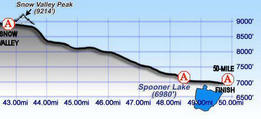
Course Description: "From the Tunnel Creek aid station, the course will follow the Tahoe Rim Trail south towards the Spooner Summit trailhead passing both Marlette Peak and Snow Valley Peak (and visiting both the Hobart Road and Snow Valley Peak aid stations)."

The Plan: Tunnel Creek to Hobart is a two-way traffic stretch. I will be there in that section between about 10 1/2 to 13 hours in. This means coming the other way I'll see 100 Milers running 18-23 hours. This means I should encounter the top 10 or so finishers! Focus on that. Watch for them; count them off.

Aid Stations: Miles 40, 43. At mile 40, get my headlamp out of my pack. With the shade of trees, I may need it before I get to the Snow Valley (mile 43) aid station. Per coach Jeremy: "Thank the boy scouts!" (at mile 43)


Miles 43 to 50


Course Description: "From the Snow Valley Peak aid station the course makes about 5.4 mile descent before reaching the Spooner Trailhead aid station at Highway 50 and connecting with the Spooner Lake trail for the final 1.7 miles to the finish."

The Plan: Um, finish? One way or another. Just finish.

Aid Stations: Mile 48.5, unmanned.


Friday, July 12, 2013

I Realized I Was Too Tough To Kill

That hill had a purpose. It showed me I was too tough to kill....

If you missed my blog entry earlier today leading into this one about my past 10 weeks sleeping in an altitude tent, the reaction of people to it, why it's not cheating in the slightest, how my metabolic efficiency has improved during that time, then check it out here!

I had an awful weekend of running. I just had an awful weekend! I was lethargic and just felt really off. Even though the heat wasn't really much worse than usual, I felt like I was absolutely melting. It was not my weekend.

I've been training well, but my miles, eh, they never look that big. And then crewing Western States, and the added stress and lack of sleep of American Airlines screwing up our travel, losing our luggage, and running around making backup plans did NOT helpful. The whole week after being home, my resting heart rate in the morning was a little high.

Based on all of that, Coach Jeremy gave me Monday off, which meant I didn't get to do hills with my running group, the North Texas Runners. I would have to do them alone on Tuesday. I admit my faith in myself was feeling a little off at this point too.

The Workout

Coach's assigned workout was 24 hill repeats on a 60 ft gain, 0.15-mile long hill. That's a solid 12% grade. It's a darn good hill. So 6.9 miles (not counting warmup) on ONE hill. And a total of 1,440 feet of uphill and downhill.  So I would get about 1/7 of the gain/loss I would experience next Saturday at Tahoe Rim Trail 50 Mile, in a little less than 1/7 of the distance.

This translated into 1 hour, 45 minutes ALONE. 100 degrees in Allen, Texas when I started at 7:15 pm, and I finished as it was just finally totally dark at 9 pm.
Just a portion of the big hill, from another NTX Runners hill night

I kept consistent splits the whole way. Powerhike hard the up (which is what I, and many ultrarunners, would be doing on the mountains at Tahoe Rim Trail), and run easy all the downs.  Only short stops at the bottom on occasion to refill my water bottle from the water cooler I brought or take a drink.

And 18 repeats into it, the mantra entered my head, and I stayed strong the rest of the way:
"AT SOME POINT I REALIZED I WAS TOO TOUGH TO KILL"
I will finish Tahoe Rim Trail 50M. It might not be pretty. I might be the last person in my distance. Let's face it: most people my pace are no doubt doing the 50K. But the hill served its purpose. I knew I could beat all the ups and downs that Tahoe will throw at me because I'm determined to finish. Note that this includes the kitty litter sand hike of 1700 ft gain in only 2 miles at Diamond Peak - the climb is legendary. Yeah, you're climbing a freaking ski slope basically.
It's a wide elevation profile, so click on it to see it big!

So let's get ready for a 15-ish hour party at Lake Tahoe next Saturday. I'm hoping to find some blogging time before I travel next Friday to document more of my mental state so I can come back to it before future races. And my mental state I mean, yes, I know we're all insane in the the ultramarathon field, but the psychology of what will get you to the start and safely get you to the finish is completely fascinating to me, and I continue to learn so much about myself!

Sleeping at 10,000 Feet - Kinda

I've alluded to this fact in past posts, but I haven't talked too much about this.

Confession: I've been sleeping on top of a high mountain.... In Dallas, Texas. 

Huh?

At the start of May, I rented a Hypoxico altitude tent to use in preparation for Bighorn Trail Run 50K in mid-June. It came on the recommendation of Twitter friend Jerry who had felt like it was really effective.

With 6 weeks initially to sleep in the tent before Bighorn, my big motivations for doing this were:

1) I never wanted to feel like I did at Jemez 2012 ever again. That race topped out at 10,400 feet, and I felt very very ill up there. We later found out my iron levels were non-existent, making my oxygen carrying capacity zilch, but I didn't know once my levels were restored, which took months, if I was still susceptible to altitude sickness. I hadn't really spent any time in a mountain environment, with or without iron in my blood cells, to know. But I knew that I felt like I was dying on Pajarito Ski Mountain in New Mexico last year. 10 steps then a minute of breathing. It took me 3 hours to go 6 hours that day before medical pulled me at mile 20 and put me on oxygen. Never again. That was a nightmare.

2) I'm already a back of the pack runner in ultramarathons. You add an altitude disadvantage in a race where most people live high, and I knew the Bighorn 50K could be a VERY. LONG. DAY. I was excited about the prospect of negating some altitude effects and running close to my slower-than-the-average-ultrarunner paces!

Reactions

I didn't make a huge big deal about the tent because I thought the reaction would be what eventually I did get in a knee-jerk way from a few people: "Hey, That's Cheating!" Or it was a joking remark where you know 50% of the time, that's how they really feel.
Um, no, it's legal blood doping. It's like the elites moving to Silverton, Colorado, and living for 4 months there before Hardrock 100. It's the difference between an Ironman who has a $10,000 bike and one with a $2,000 bike.
It does not REPLACE training. It just helps to give an edge on top of whatever you bring to the party. Which means if you don't train right, it can only do so much.

The next reaction is "Oh my gosh, is it expensive?" The unit is actually rent-to-own for up to 8 weeks of use. So at any time up to the end of 8 weeks, I had the option to buy the Hypoxico altitude tent system I had been using and apply all my rental dollars directly to the overall cost.

This is what I eventually chose to do. After 6 weeks of use for Bighorn, I had 5 more weeks to the Tahoe Rim Trail race, so in buying it, I actually made up about half the cost in what that additional 5 week rental would be. And if I use it for just one more 6 week period in the next couple years, I'll have equaled out to what renting it the whole time would have cost. For the stupid crazy stuff we athletes can spend our money on, I found it rather affordable.
If you look in your closet and find any Lululemon apparel, you can afford it. If you have an expensive tri-bike, you can afford it. If you have multiple pieces of name brand running apparel or 10 pairs of running shoes not bought on clearance, you can afford it.
The last anticipated reaction I thought would come, and may have but people wouldn't say it to my face, is "Who Does She Think She Is?!?"
Yeah, I'm no elite. Far from. And a lot of the elites are using this system - Hal Koerner used it before winning Hardrock 100 last year, Timmy Olson used it this year, Karl Meltzer used it before Bandera 100K in January, Devon Yanko and her husband sleep in one, and the list goes on with many other high profile names.
But where those folks might see a 0.5% improvement to VO2 at the same effort, I see big improvements. And that's pretty cool. I actually provided all my pre-use and post-Bighorn metabolic testing data to Hypoxico in the hopes that it helps them show what this tent can do for "ordinary" or "average joe" ultrarunners like myself. I know teams of doctors follow the elites around, testing them routinely, but there are few like me using the tent, and probably fewer quantifying the improvements made by the tent.

So What Is This Thing?

There's a generator that produces some humming white noise, but the hose attachment to the tent is long so I put it at the far away end of our master bathroom, and it's not too noisy there. Good ambient noise anyway.

My tent is made for a queen sized mattress. They also make one for king size. The mattress and everything goes into the tent. The tent itself didn't take too much work to put together. Getting the big mattress in was actually the hardest part.

It is actually quite spacious inside. I can sit up in it without a problem. At night, here's my view:

A hose runs from the generator through a hole into the tent. The tent has giant flaps on each side that can be zipped open during the day when you aren't sleeping and folded up on top of the tent. The hose lets in the right oxygen level and when it's zipped up, the pressure in the tent is simulated to the high altitude then too.

Occasionally, during the day, I even work on my computer from the tent.
Cinna sees VO2 improvements too
It is hard to just jump out of at a moment's notice. You are zipped into this tent of plastic.
Plastic everywhere!

And it does get a little warm with all the plastic. Usually we keep our house at 76 degrees and a low ceiling fan setting in the master bedroom. With the tent and probably a little from the heat created by the generator in the bathroom, I kept the house each night at 74 degrees and a medium ceiling fan setting in the bedroom.


How do you do it?

Week 1 I started out at 4,000 feet altitude and slowly moved it up nightly until I was at 8,000 feet altitude. Hang out here a couple days, before I moved it up until I was at 9,000 feet altitude. I'm not going to lie - you sleep pretty bad during the adjustment time. It's very restless sleep. And I'm usually a pretty deep sleeper.

Once adjusted though, it's no different from a normal night... except you are in a plastic tent.

It takes 3-5 weeks to start seeing effects. I used it for 6 weeks leading up to Bighorn.

After Bighorn, I actually moved up to 10,100 feet of altitude. My oxygen saturation typically shows 87-90% at this altitude, versus the 98% we all walk around at if we're in good physical condition.

The system also had an exercise kit, where I can hook a mask up to the generator with a hose and run on a treadmill. I did this a handful of times, but for my use of time and the training I was doing, it was easier for this training phase to just go with the passive tent use.

There was also a suggested protocol, called Intermittent Hypoxic Training, where you sit for an hour a day. 5 minutes with the mask on, 5 minutes with it off. BUT the generator was set to 21,000 feet. In the life of a busy mom, I just couldn't make use of this protocol much. A dedicated hour of sitting doesn't come often. And at 21,000 feet, you can't just hang out and work on the computer. Your energy gets zapped and you just focus on not passing out. I'm not a doctor, but it refines alveoli in the lungs or some other such useful but not required aspect of adjusting to altitude.

Does It Work?

The elites seem to think so, and I personally think so too.

Right before Bighorn, we redid my metabolic testing, and without a big change in quality of workouts or total mileage, I saw great improvements.


Other sea level runners at Bighorn said they could definitely feel the altitude. Aside from an expected heart pounding in the head feeling on big uphills in the race, which would have been tough uphills even at sea level, I felt like I was able to run my normal paces at home. Even better...

Bandera 50K in January - very little climb, technical course - 9:52

Bighorn 50K in June - 5000 ft ascent, 8500 ft descent, technical course, 7000-8500 feet altitude most of the way - 9:30 (and that included going off course for 1.2 miles, so roughly 20 minutes off-course)

I knew I would be happy if I beat my Bandera time, so I was thrilled with this finish. And the tent helped give some confidence to pursue a race like Bighorn. Aside from me and my good friend Lesley, the other 30+ women in our age group were all from the 5 states right there around the race where they live at higher altitude.

I will stop using the tent once I go to Tahoe Rim Trail 50M next Saturday, and then I'll be able to tell you if it worked for that race, which averages about 9000 feet altitude the whole way.

In the meantime, I'm sharing the love and lending the tent to a friend who is training for Leadville 100, so he can enjoy 4 weeks of the effects!